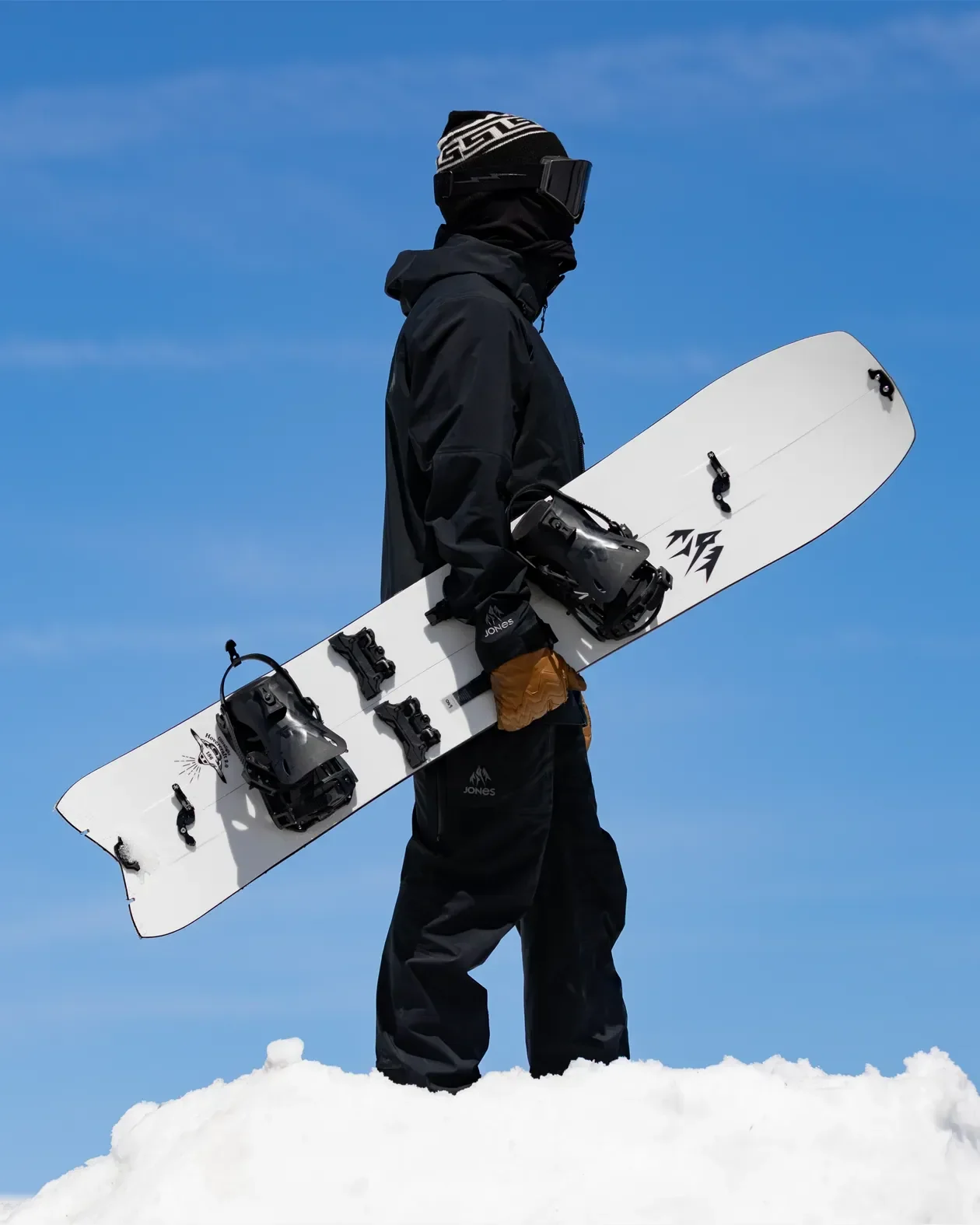
When the powder objective sits beyond a long approach, the Ultralight Hovercraft 2.0 brings Fusion Carbon to the short, wide powder concept. It targets riders who prioritise construction weight while keeping a distinctly directional ride for the descent.
Is the Jones Ultralight Hovercraft 2.0 Splitboard 26/27 right for you?
The Ultralight Hovercraft is aimed at powder objectives beyond an easy lift-accessed lap. It combines the Hovercraft’s short, wide approach with a more elaborate carbon construction. The practical intention is straightforward: less board weight on the way to the descent. Whether that merits the extra cost depends heavily on how often those long approaches actually feature in your season.
The first decision comes before the material choice. You are selecting a directional powder outline with a wide nose and narrower tail. That surface distribution is attractive in soft snow. If firm traverses and variable spring conditions are common, the lowest construction weight should not make the decision for you. Width and effective edge also have an important influence on handling.
How does it fit your approach, size and setup?
The standard Hovercraft 2.0 is the obvious comparison if you want the same general direction at a lower cost. The Butterfly pursues a different idea: a compact touring specialist rather than a broad powder shape. Our old Ultracraft reports provide useful context for Jones’ lightweight powder boards, but they are not measurements or riding confirmation of this current Ultralight version.
| Your decision | Our assessment |
|---|---|
| A good fit for | Distant powder objectives and deliberate setup-weight planning |
| Think more carefully about | Mostly short approaches, or an only board for predominantly firm conditions |
| Compare directly | Jones Hovercraft 2.0 Splitboard and Jones Ultralight Butterfly Splitboard |
What have we learned from earlier seasons?
Our 17/18 Ultracraft coverage already explored Jones’ lightweight powder direction. The archive centres on low weight, a flotation-oriented nose and a firm tail for control. Those observations help explain the attraction of a lightweight powder split on longer tours. The Ultracraft is nevertheless a different version from the current Ultralight Hovercraft 2.0. We do not calculate present-day weight savings from its old carbon build. It remains a historical comparison; current 26/27 dimensions are listed separately below.
Read the original report: Jones Ultracraft 17-18.
What has changed since 25/26 and earlier models?
This model already appeared in our 25/26 gear guide. When comparing purchases, check the appropriate size, exact version and the dimensions below. The current manufacturer page does not provide a complete construction change log, so a fresh graphic alone is not a reason to promise a different ride.
A specific data comparison for 152 cm, using our archived 25/26 page and the current manufacturer data:
| Detail | Archived 25/26 | Current 26/27 |
|---|---|---|
| Board weight (manufacturer) | 2.5kg / 5.6lbs | 2,5kg / 5,6lbs |
| Waist width (cm) | 25.9 | 25.9 |
| Radius (m) | 8.7 | 8.7 |
| Taper (mm) | 17.0 | 17.0 |
These are manufacturer and archive figures, not differences measured by us. Matching dimensions alone do not establish identical construction.
FAQ: What should you know before your first tour?
Is the Ultralight worth it over the standard Hovercraft?
It deserves closer consideration when long ascents and carrying sections are regular features. For short powder laps, the standard Hovercraft may be the more sensible purchase. Compare equivalent lengths and the complete setup weight.
Which Jones Ultralight Hovercraft 2.0 Splitboard size should I choose?
Current listed lengths are 152, 156, 160 cm. Start with the rider-weight range for each length, then check boot width and stance. Frequent kick turns favour manageable equipment; extra length purely for assumed flotation is not a universal solution. Reference points from the table: 152 cm: 110-160 lbs. / 49-73 kg., waist 25.9 cm; 156 cm: 130-180 lbs. / 59-82 kg., waist 26.3 cm. These are manufacturer recommendations, not weight limits established in our tests.
Which other boards should I compare?
Jones Hovercraft 2.0 Splitboard: Powder, tree tours and compact directional turns. Jones Ultralight Butterfly Splitboard: Long approaches, repeated kick turns and experienced riders. Choose around your usual tours and an appropriate size rather than favouring a model purely because of its position in the price list.
What original test experience do we have?
There is historical evidence: Jones Ultracraft 17-18. It concerns 17/18 and is discussed above. It is a comparison with an earlier generation or related variant, not an identical 26/27 field test.
What do I need in addition to the board?
You need a compatible splitboard-binding system, suitable boots and skins matched to the length and attachment points. Where Jones specifies a skin group in the table, use it when selecting skins. Compare complete offers: the board price alone does not tell you what a ready-to-tour setup will cost.
Is an earlier-season version worth considering?
Yes, when model, size and condition suit you. Compare the specific model-history information rather than only the year label. For a used board, inspect the base, edges, inserts and connectors. An earlier test score cannot replace a condition check.
Which sizes and specifications are available?
Sizes: 152, 156, 160 cm. Profile: Float CamRock. Manufacturer flex: 8/10.
The table contains manufacturer figures for the specified lengths.
What are the measurements for each size?
| Board size (cm) | 152 | 156 | 160 |
|---|---|---|---|
| Weight range (lbs/kg) | 110-160 lbs. / 49-73 kg. | 130-180 lbs. / 59-82 kg. | 160-210 lbs. / 73-95 kg. |
| Ideal boot size (US / EU) | US 7-9 / EU 39.5-41.5 | US 9 / EU 41.5 | US 11 / EU 44.5 |
| Board waist width (cm) | 25.9 | 26.3 | 26.7 |
| Skins group | C | C | E |
| Board size (cm) | 152 | 156 | 160 |
|---|---|---|---|
| Board weight | 2,5kg / 5,6lbs | 2,7kg / 5,9lbs | 2,8kg / 6,2lbs |
| Surface area (dm2) | 42.83 | 41.1 | 39.41 |
| Contact length (cm) | 97.3 | 100.5 | 103.7 |
| Effective edge length (cm) | 119 | 123 | 126 |
| Tip length (cm) | 39.6 | 40.0 | 40.4 |
| Tail length (cm) | 15.1 | 15.5 | 15.9 |
| Waist width (cm) | 25.9 | 26.3 | 26.7 |
| Underfoot width - front foot (cm) | 27.2 | 27.7 | 28.1 |
| Underfoot width - back foot (cm) | 26.7 | 27.1 | 27.6 |
| Tip width (cm) | 30.6 | 31.1 | 31.6 |
| Tail width (cm) | 28.9 | 29.4 | 29.9 |
| Sidecut radius (m) | 8.7 | 9.0 | 9.3 |
| Taper (mm) | 17.0 | 17.0 | 17.0 |
| Reference stance (cm/in) | 54.0 / 21.3 | 56.0 / 22.0 | 58.0 / 22.8 |
| Centered stance (cm/in) | 54 / 21.3 | 56 / 22.0 | 58 / 22.8 |
| Insert pack | Splitboard Pack | Splitboard Pack | Splitboard Pack |
| Stance setback (cm) | 0 | 0 | 0 |
Where do the information and images come from?
Jones Snowboards: Jones Ultralight Hovercraft 2.0 Splitboard, manufacturer information checked 15 October 2026. Product images: manufacturer. Earlier original coverage: Jones Ultracraft 17-18.
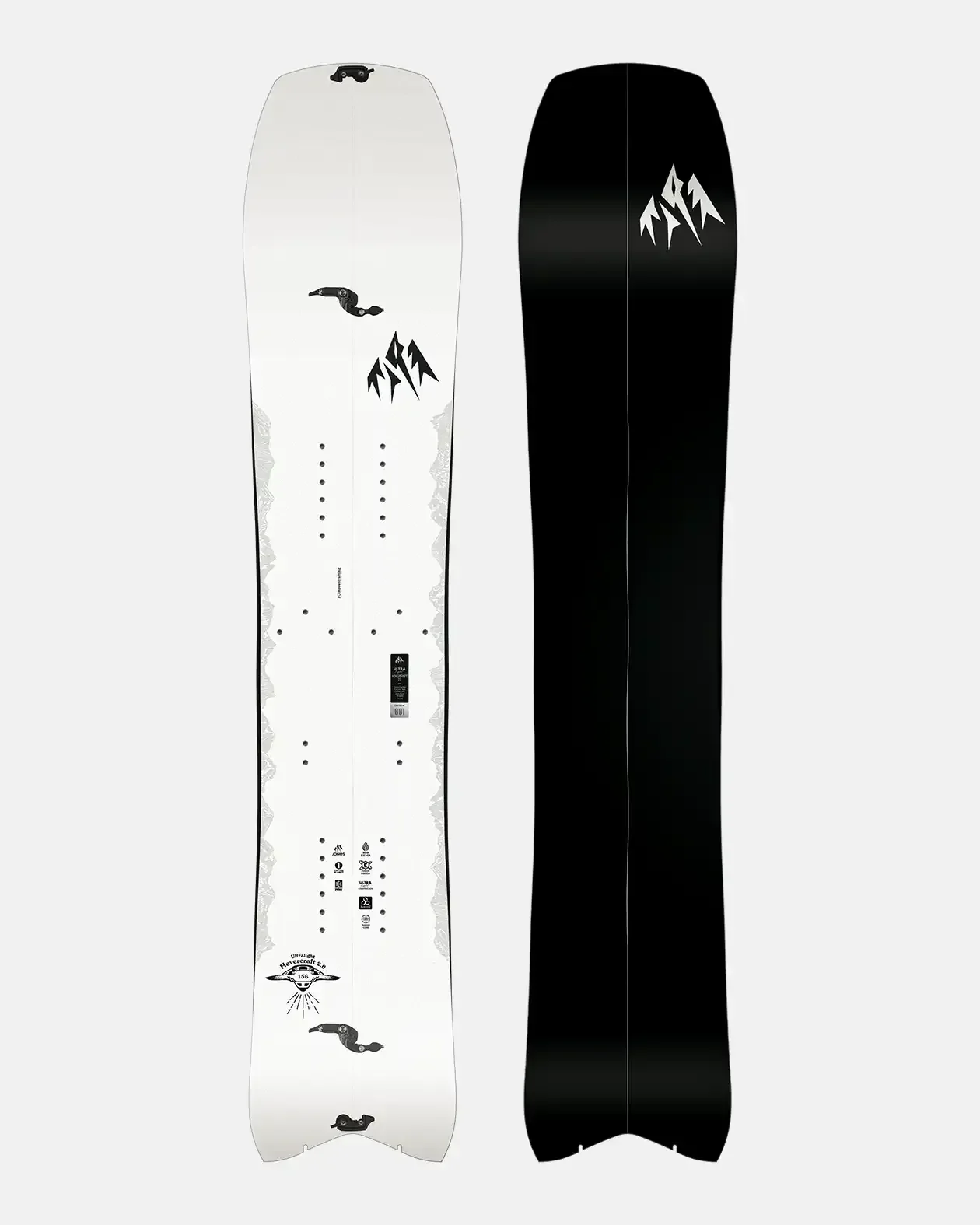
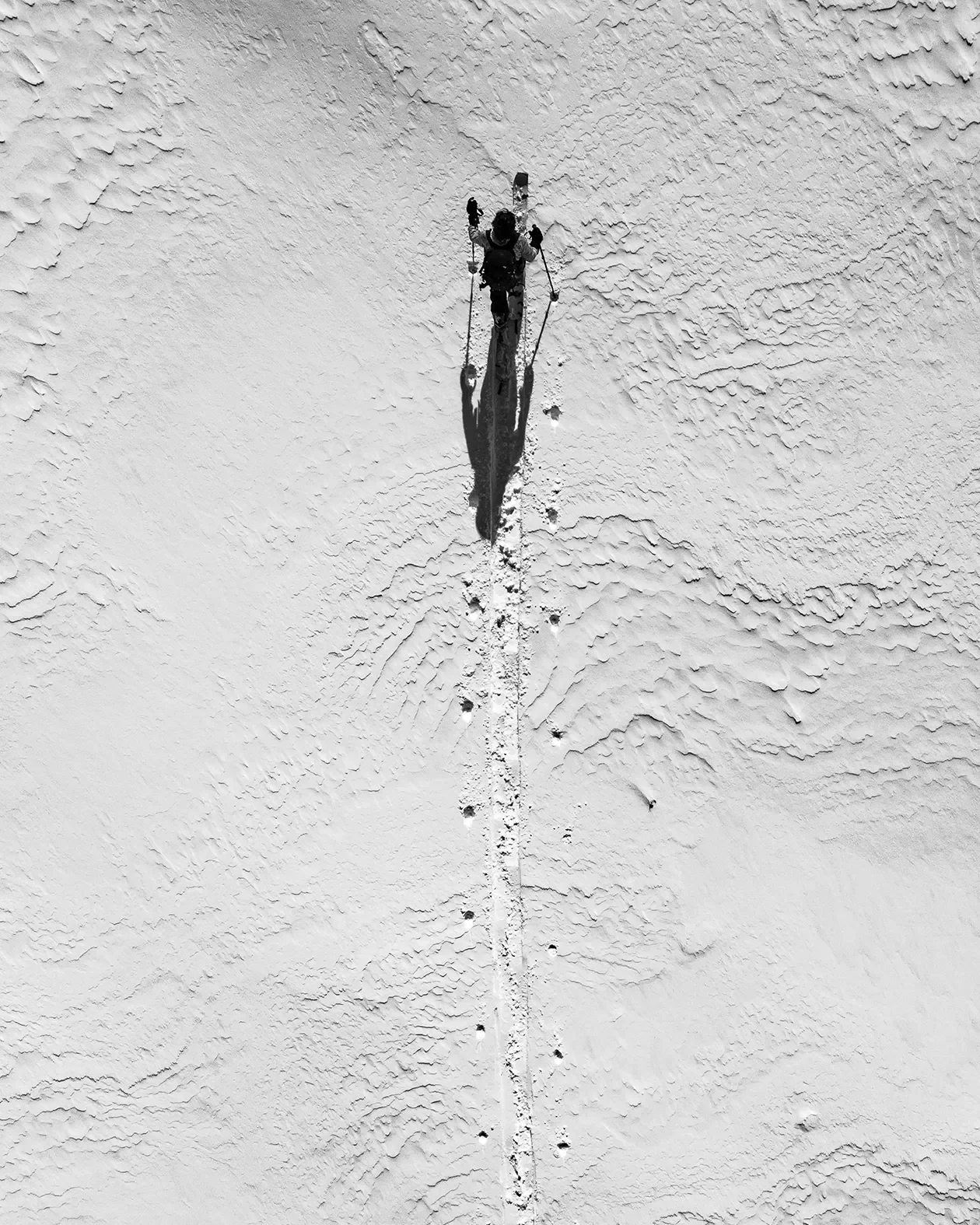
What does the board look like? (5 photos)


Show 1 more images